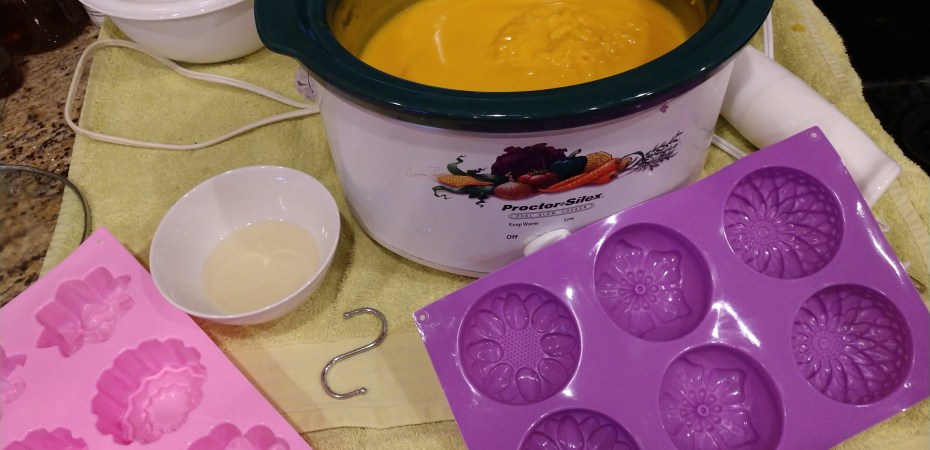
A fabulous colleague of mine asked today for the how-to of making soap. Although we’ve got about a dozen soap recipes around here, I’ve never explained the process.
First, you should know that all my soap is hot process. Basically, that means that I use heat, provided by a crock pot, to hurry up the saponification process. It is never, ever as pretty as cold process soap. When you cook it like I do, nothing is left at the end that is caustic, which is important to me because I have pets and am personally infamous for being vaguely disaster prone. Chemical burns are no joke and hot process soap reduces the amount of time that you’ve got stuff that’s nasty hanging around your kitchen. It also means that the soap is ready to use after just a few days. You could technically use it immediately, and I always do test a little bit of it when I clean the crock pot out, but it lasts longer if you leave it to dry out a bit.
You’re going to need some equipment:
- A big, nonreactive bowl (I use stainless steel)
- A cheap immersion blender
- A kitchen scale (I talk about precision in measurement here.)
- A slow cooker that you don’t want to use for food again (I use a 4 quart one, smaller ones have trouble with bubbling over at the 1kg batch size)
- Goggles, the splash proof kind (I use these: https://smile.amazon.com/gp/product/B007JZ37FO/)
- I don’t wear gloves, but I should and so should you
- Cheap vinegar, a lot of it, for cleaning your equipment and also for pouring on you if you get lye on yourself
Now about ingredients. Each recipe calls for different kinds of fats. Some add sugar or coffee or other goodies. But all of them use water and lye. Always use distilled water. The variable mineral content of tap water can impact your soap in strange and unpredictable ways.
Lye is a generic word for a metal hydroxide. When we’re talking about solid soap when I say lye what I really mean is sodium hydroxide. Liquid soap uses potassium hydroxide and is a much longer and somehow less predictable process. I use the California Soap Supply sodium hydroxide:
https://smile.amazon.com/Soap-Hydroxide-soapmaking-California-Supply/dp/B01L86JSY8/
I use either The Sage or Brambleberry for lye calculators. Use the recipes as a general guide, but you don’t have to have perfect precision in your pours. Get close enough and then plug your actual amounts into a lye calculator to ensure that your lye and water amounts are correct for your batch.
Process
Measure out your fats and put them in the slow cooker on low. I just use a clean lightweight plastic bowl for the measuring part so that I don’t introduce error into my rather cheap digital scale when I tare it.
Pick any of the recipes you like. Veronica’s favorite is always a hit. Take notes of the actual amount of each you’ve managed to pour so that you can check the lye and water required using one of the lye calculators. When you use the calculators, they will ask you for a superfatting level. Superfat is the amount of unreacted fat left over at the end. It is what makes a bar more or less moisturizing and having a buffer of it will make sure your soap isn’t caustic, so it will not burn sensitive skin. 5% is sort of the default. Some of my moisturizing bars go up to 8%, but those must be used fairly quickly, as unreacted fat can eventually rancidify, which is gross. Veronica’s soap is 5% superfat. I don’t recommend ever going below that for a general use soap.
Once your fat is in the crock pot on low, let it all melt. If there is a setting below low on your slow cooker, turn to that.
Now you can measure out your lye and your water. I use a small glass bowl to measure the lye on the scale. I use a plastic cup to measure the dehydrated water. Do them by by weight or mass on the scale just like your fats.
In the sink or outside near a water hose, put your distilled water into your big, nonreactive bowl. Slowly, carefully, without inhaling any of the fumes, stir in your lye.
NEVER ADD WATER TO LYE. ALWAYS ADD LYE TO WATER.
Doing that in the wrong direction is a great way to get lye solution everywhere.
Stir with a nonreactive spoon (stainless is ideal, I use my regular soup spoons and they clean up fine) until the lye is completely dissolved. It will be hot and smelly. Wait until it cools a bit before you do anything with it. Warm is fine, it doesn’t have to be cold or room temperature, but it’s really going to be hot for a few minutes after you first mix it. Be patient. If you pour it into the fats too hot, it’s all going to want to bubble over.
Once it’s no longer hot to touch the outside of the bowl containing the lye solution, slowly and gently pour it into the fats.
Using the lowest speed on your immersion blender, start to blend. Veronica’s soap only takes a couple of minutes to get to the right texture. It’ll be like custard. People call this stage ‘trace’. Here’s a youtube video about it:
https://www.youtube.com/watch?v=X5zPU_7u0i4 What you’re really looking for here is complete emulsification. No oil hanging out on top, consistent and non-separating.
Once you’re there, you can stop stirring. Cover the slow cooker, make sure it’s on the lowest setting, and let it cook for about 45 minutes. It’s going to go through some interesting changes. It’s going to gel. It may or may not try to bubble up over the edge of your slow cooker. If you turn your back for an instant, even for so long as it takes to put the kettle on, it will take that exact moment to bubble over. If it starts to do that, just take the lid off and stir it back down. I put a towel under my slow cooker to protect the countertops in case I have a failure to pay attention.
After 45 minutes, you can add scent and any flower petals if you like and scoop it into molds. If I’m using a big soap mold, I add the scent once it’s in the mold and a few degrees cooler. That’s too fussy if you’re using little ones. Some of your scent will evaporate because of the heat if you add it directly to the slow cooker, so use extra and scoop it into the molds immediately.
Let the soap cool completely in the molds, I leave mine overnight, then turn out and dry on a rack (I have a baking rack just for soap drying, but see no reason you couldn’t wash it thoroughly and keep using it for cookies later) for at least three days, but up to two or three weeks. The longer your soap cures, the longer the bars will last. I’m still using soap I made nine months ago, but it doesn’t feel quite so luxurious as it does after only three weeks.
The soap in the post about precision in measurement above had mica dusted into the molds (and some stirred right into the soap). Here’s a link to the mica I was using:
https://smile.amazon.com/gp/product/B0759DH4ZG/ . Searching “dried flowers for soap making” on Amazon will also turn up all the stuff you could ever want for pretty stir-ins. If you only want it on the top, just put it in the mold before you pour in the soap.
Good luck!
 Pirate Astronaut Chicken Farmer